📢 LIVE M&E TRAINING STARTS 24 NOVEMBER 2026
LEARN TO MEASURE WHAT PROGRAMMES ACHIEVE, NOT JUST REPORT WHAT THEY DO.
Develop the practical skills to design effective M&E frameworks, track programme performance, analyse data, and turn findings into actionable insights that support better decisions.
RESERVE MY SEAT FOR ₦100,000 8 Live Sessions • 20 Hours • Starts 24 November 2026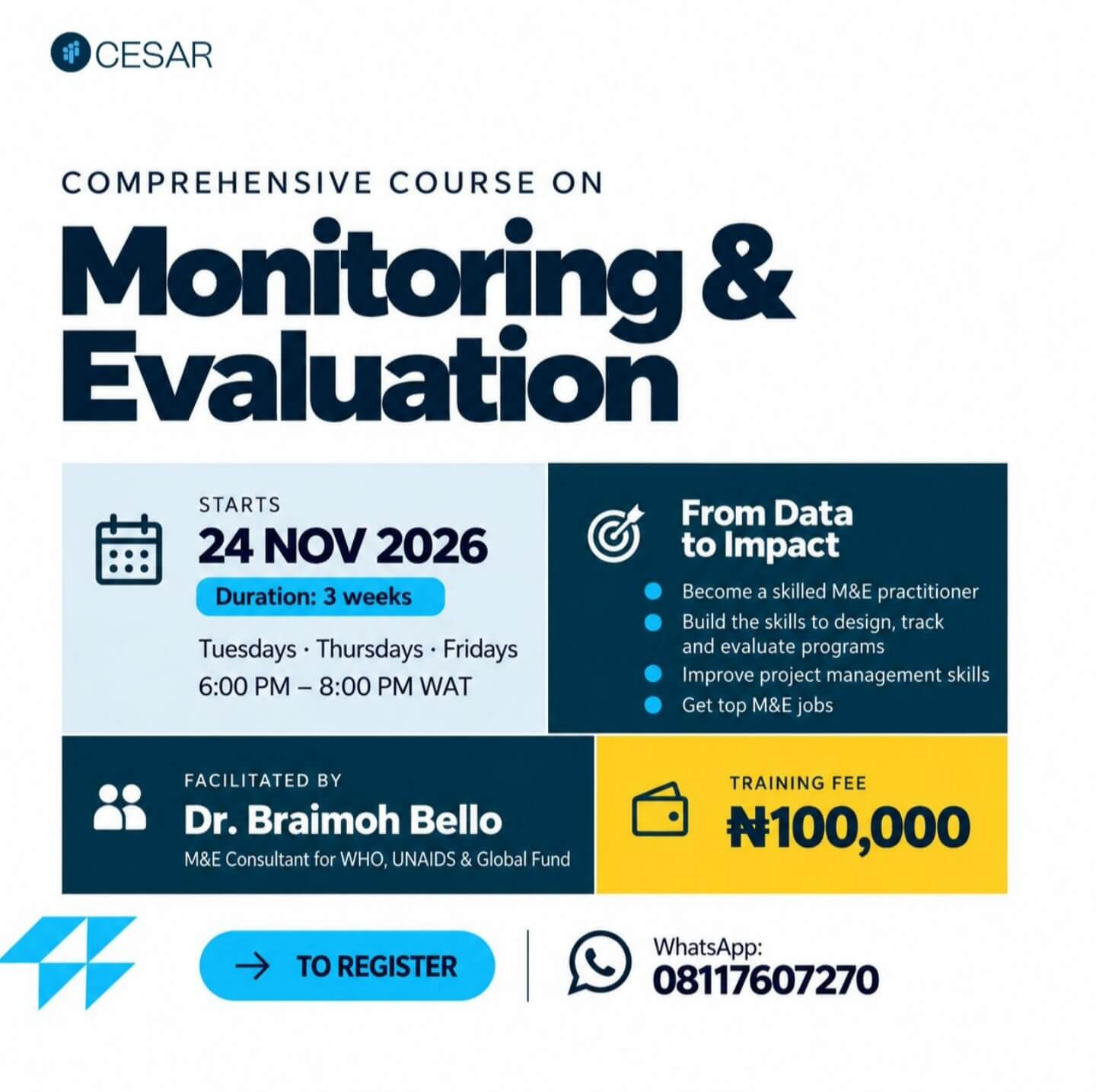
YOU ALREADY USE EXCEL.
NOW LEARN TO GET MORE OUT OF IT.
Working with Excel shouldn't mean spending hours fixing messy spreadsheets, repeating calculations, or putting reports together manually. Over three weeks, you'll learn practical techniques to clean, analyse, and visualise data more efficiently.
About the M&E Training
Monitoring and Evaluation (M&E) plays a critical role in ensuring that projects and programmes achieve their intended objectives. Across development, public health, government, and other sectors, effective M&E helps organisations track progress, assess outcomes, demonstrate accountability, and make better use of their resources.
CESAR's Comprehensive Course on Monitoring & Evaluation is designed to give you a solid grounding in M&E principles and their practical application. Whether you're new to the field or already involved in managing programmes, you'll develop the knowledge and skills to plan, implement, and use M&E systems effectively.
Understand how effective M&E works
Build a strong foundation in the principles of monitoring and evaluation, results-based management, and programme planning. Learn how to develop logical frameworks, define performance indicators, and establish measurable targets that connect programme activities to intended results.
Turn programme data into actionable insights
Go beyond simply collecting and reporting data. Learn how to select appropriate data collection methods, analyse results, interpret findings, and communicate evidence that supports programme improvement and informed decision-making.
Practical M&E skills you'll build
Throughout the training, you'll develop practical skills across five essential areas of Monitoring and Evaluation.
M&E Principles and Foundations
Understand the purpose of monitoring and evaluation, the differences between them, and how M&E supports programme management, accountability, and decision-making.
Monitoring
Routine trackingAre activities on track?
Evaluation
Periodic assessmentWhat changed, and why?
- Monitoring
- Evaluation
- Accountability
- Decisions
M&E Frameworks and Performance Indicators
Learn to develop theories of change, logical frameworks, SMART indicators, and realistic performance targets for measuring programme results.
- Theory of change
- Logframes
- SMART indicators
- Targets
Data Collection and Management
Explore quantitative and qualitative data collection methods, develop appropriate data collection instruments, and learn how electronic tools can support more efficient data gathering.
| A | B | C | |
| 1 | Record | Method | Status |
|---|---|---|---|
| 2 | R001 | Survey | Ready |
| 3 | R002 | Interview | Review |
| 4 | R003 | Field visit | Ready |
- Quantitative
- Qualitative
- Electronic tools
- Data management
Data Analysis and Interpretation
Learn to analyse M&E data using Microsoft Excel, interpret findings accurately, and identify what the evidence reveals about programme performance.
- Microsoft Excel
- Interpretation
- Performance
Reporting, Learning and Evidence Utilisation
Develop clear M&E reports, communicate findings to stakeholders, and translate evidence into practical recommendations. You'll also explore how M&E contributes to MERLA and how AI tools can support aspects of the M&E process.
Programme learning brief
Evidence into action- Finding
- Two of four sites are below the 80% reach target.
- Recommendation
- Focus follow-up support on Sites A and C.
- Learning
- Use the findings to adapt next month’s plan.
- Reporting
- Evidence use
- MERLA
- AI support
Who Is This Course For?
- M&E Officers and Coordinators
- Programme and Project Managers
- Government and Public Sector Professionals
- NGO and Civil Society Professionals
- Donor Agency and Foundation Staff
- Policy Analysts and Advisors
- Health Programme Managers and Public Health Professionals
- Researchers Working in Applied and Policy Settings
- Postgraduate Students in Development, Public Health, and Social Sciences
Course outcomes
Upon completing this course, participants will have a thorough grounding in the meaning, theory, and practice of M&E and the practical skills to design and implement M&E systems that generate credible, decision-relevant evidence.
Participants will leave not only understanding what M&E is, but also knowing how to design and implement it effectively in their own organisational contexts. You'll also learn how to use artificial intelligence tools to support key stages of the M&E process.
Course Outline
Virtual (5 Weeks)
Week 01Introduction to Monitoring & Evaluation |
|
|---|
Week 02M&E Frameworks and Performance Indicators |
|
|---|
Week 03Data Collection for M&E |
|
|---|
Week 04Data Analysis and Interpretation |
|
|---|
Week 05Reporting, Evidence Utilisation and Synthesis |
|
|---|
COUNTDOWN TILL EVENT
TRAINING DETAILS
| Start Date: | Tuesday, 24 November 2026 |
|---|---|
| Class Days: | Tuesdays, Thursdays and Fridays |
| Time: | 6:00 PM – 8:00 PM WAT |
| Duration: | 3 Weeks |
| Venue: | Online via Zoom |

JOIN THE M&E TRAINING
₦100,000
Comprehensive Monitoring & Evaluation Course
- 20 hours of live instruction
- 8 Zoom sessions over 3 weeks
- Recordings, templates and tools
- Certificate of completion
Training starts
FREQUENTLY ASKED QUESTIONS
No. The course covers the fundamentals of M&E before moving into practical frameworks, methods, and applications. It's suitable for beginners as well as professionals looking to strengthen their existing knowledge.
The training is suitable for M&E professionals, programme and project managers, NGO workers, government officials, public health professionals, researchers, and anyone interested in developing practical M&E skills.
Yes. You'll learn about theories of change, logical frameworks, performance indicators, and target setting, including how these tools support programme planning and performance measurement.
Yes. The course includes analysing and interpreting M&E data using Microsoft Excel, alongside techniques for reporting and communicating findings.
Yes. You'll explore quantitative and qualitative data collection approaches, data collection instruments, and electronic methods used in Monitoring and Evaluation.
The training begins on Tuesday, 24 November 2026, and runs for three weeks. Classes are scheduled for Tuesdays, Thursdays, and Fridays from 6:00 PM to 8:00 PM West Africa Time.
The training fee is ₦100,000, as advertised for this Nigerian cohort.
Use the registration button on this page or contact CESAR via WhatsApp on +234 811 760 7270 for registration assistance.